
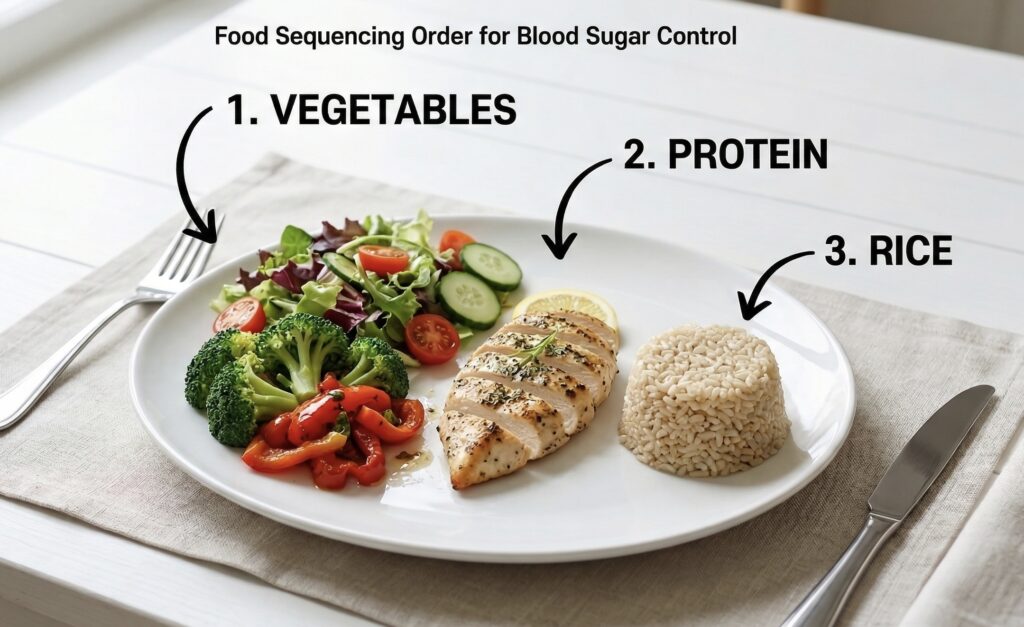
Eat in This Order and Your Body Will Thank You — The Science of Food Sequencing
I used to think healthy eating was about what I put on my plate.
Turns out, the order matters just as much.
I came across food sequencing a while back and honestly thought it sounded a little too simple to be real. Just… eat your vegetables first, then protein, then carbs? That’s it? That’s the big health secret?
But the research behind it is genuinely solid — and once I tried it for a few weeks, I noticed enough of a difference to keep going. Less sluggishness after meals. More stable energy in the afternoon. Less of that “I need something sweet” craving an hour after eating.
Here’s everything I’ve learned about why it works.
What Is Food Sequencing?
Food sequencing — sometimes called “reverse eating” or the “food order method” — is the practice of eating the components of your meal in a specific order:
① Vegetables (fiber) → ② Protein & Fat → ③ Carbohydrates
That’s it. Same food, same portions, same calories. Just a different order.
The idea has been around in nutritional research for years, but it’s gotten a lot more attention recently as scientists look into blood sugar management beyond just counting carbs. And the evidence is building up fast.
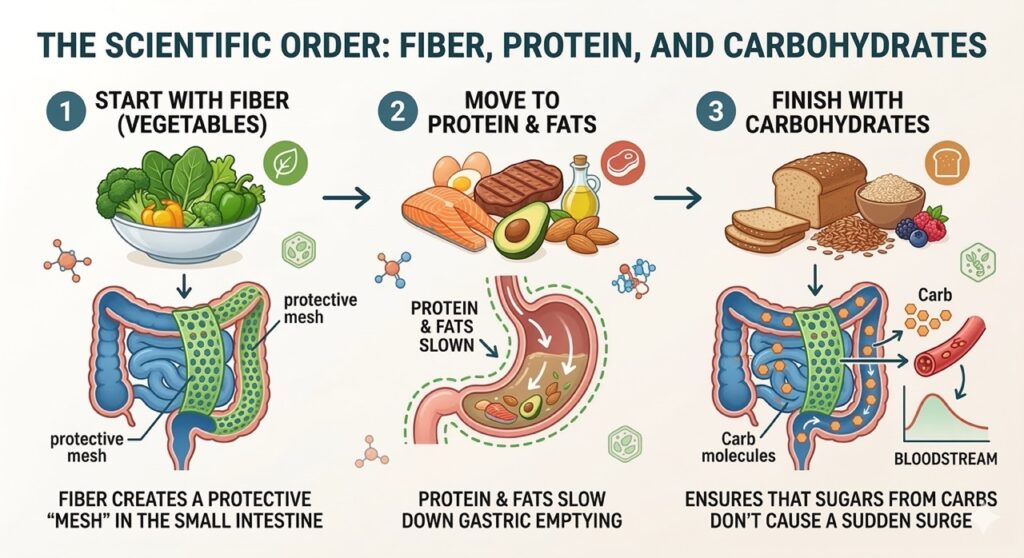
Why Order Actually Matters — The Science
Here’s what happens inside your body when you eat carbs first (the way most of us were raised to eat):
Carbohydrates break down quickly into glucose and rush into your bloodstream. Blood sugar shoots up. Your pancreas releases a surge of insulin to deal with it. Blood sugar drops. You feel tired, foggy, hungry again — and reach for something sweet. That cycle repeats all day.
Now here’s what happens when you eat fiber first:
When you consume fiber first, it creates a kind of protective mesh in your small intestine that slows down the rate at which glucose from carbohydrates enters your bloodstream. Then protein and fat slow things down even further. By the time the carbs arrive, your body can process them calmly and steadily instead of scrambling to catch up.
The blood sugar curve goes from a sharp spike to a gentle wave. And that difference compounds over every meal, every day.
What the Research Actually Shows
This isn’t just theory — the studies are quite specific about the results.
A January 2025 study published in Diabetes Care found that eating carbohydrates last reduced post-meal blood glucose peaks by 44% compared to eating carbohydrates first — in controlled conditions, measuring real blood glucose with continuous monitors. That’s not a small difference.
Earlier research found that eating protein-rich food and non-starchy vegetables before concentrated carbohydrates reduced the incremental glucose peaks by over 50% compared to eating the same foods in reverse order.
And it’s not just about blood sugar numbers. Research shows that starting with fiber and protein leads to more satiety and fewer cravings, better energy and focus after meals, and fewer energy crashes — no more post-lunch slump.
| What Changes | What the Research Shows |
|---|---|
| 🩸 Blood sugar spike | Reduced by up to 44–50% |
| 💉 Insulin response | Significantly lower peak insulin |
| 😴 Post-meal energy crash | Noticeably reduced |
| 🍽️ Satiety & cravings | More full, fewer cravings after eating |
| ⚖️ Long-term weight | Supports better weight management |
| 🫀 Cardiovascular health | Reduced glycemic variability = less vascular stress |
Why This Matters Even More After 50
As you age, the cells in your pancreas that produce insulin become less efficient, which affects how your body controls blood glucose levels. That means the same meal you ate at 35 can hit very differently at 55.
Food sequencing doesn’t ask you to eat less, cut anything out, or follow a complicated plan. It just works with what your body is already doing — and makes it easier for your system to handle the food you’re already eating.
For anyone managing energy levels, weight, digestion, or just trying to feel better throughout the day — this is genuinely one of the lowest-effort, highest-return habits I’ve come across.
How to Actually Do It — Practical Tips
At a Korean or Asian meal: Kimchi and namul (vegetable sides) first → tofu, meat, or fish → rice or noodles last
At an American meal: Salad or roasted vegetables first → chicken, fish, or eggs → bread, pasta, or potatoes last
At a restaurant: Start with the salad or soup (no croutons first) → eat the protein portion → then go for the bread or starchy side
Mixed dishes (bibimbap, pasta, casserole): If you can’t separate them, just make sure the dish has protein and vegetables in it alongside the carbs — that already helps compared to eating carbs alone.
One practical note: research shows that eating vegetables first reduces post-meal blood glucose and insulin even when eating speed is faster Boozy Burbs — so you don’t need to eat slowly for this to work. Just start with the vegetables, and the rest follows naturally.
One Last Thing
Food sequencing isn’t a diet. There’s nothing to eliminate, nothing to count, nothing to buy.
It’s just a reorder. Vegetables. Protein. Carbs.
I’ve been doing it long enough now that it feels completely automatic — I just reach for the vegetables first without thinking about it. And the afternoon energy crashes I used to blame on “just being tired” have mostly disappeared.
Worth trying for a week and seeing how you feel. 😊