
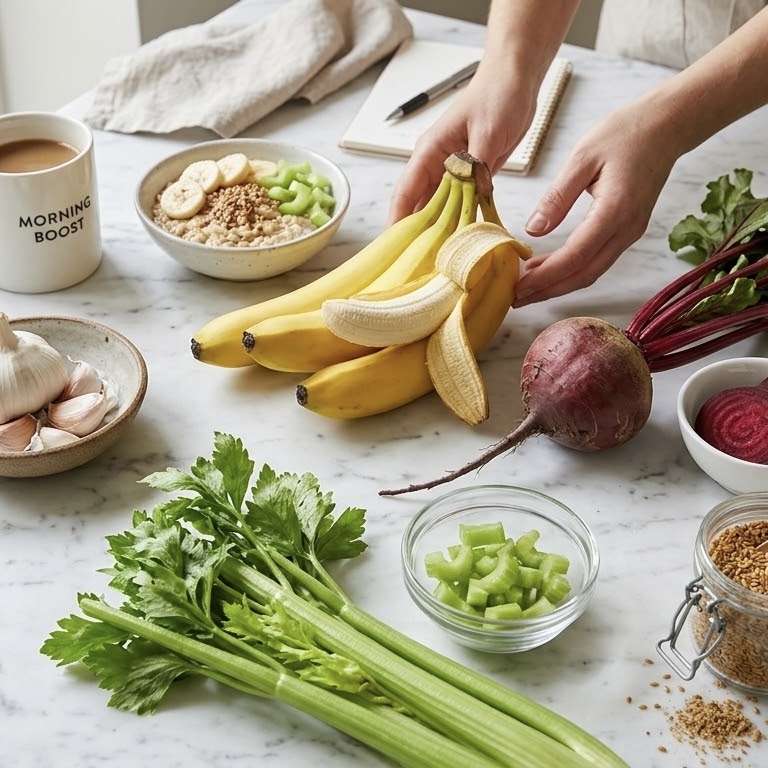
5 Foods to Eat Every Morning for Better Blood Pressure
Blood pressure is one of those things you don’t think about — until you have to.
By the time the numbers creep up, it’s usually been quietly building for a while. The good news? What you eat in the morning — on an empty stomach — has a more direct impact on blood pressure than most people realize.
These 5 foods won’t replace medication if you need it. But each one is backed by real research. And adding even two or three to your morning routine is a genuinely low-effort, high-return habit.
① Garlic — The Most Researched Food for Blood Pressure
Garlic has been studied more extensively for blood pressure than almost any other food — and the results are hard to ignore.
Garlic contains allicin, a compound that increases production of nitric oxide and hydrogen sulfide — both of which lower blood pressure. Allicin also suppresses angiotensin, the hormone responsible for constricting blood vessels and raising blood pressure.
The key is how you prepare it. Crush or mince the cloves first, then wait 10 minutes before eating. That waiting time is what activates the allicin. Skipping it means skipping most of the benefit.
One study found garlic’s blood pressure effects comparable to prescription medication after 24 weeks of consistent use — with benefits seen at doses equivalent to just two cloves daily.
Raw is most effective. But if raw garlic is too strong for you first thing in the morning, eat it with a small piece of bread or a spoonful of yogurt. Cooked garlic still provides meaningful benefits — just slightly less than raw.
② Banana — The Easiest Win in Your Kitchen
Here’s one you probably already have. The question is just whether you’re eating it intentionally.
According to the American Heart Association, potassium directly reduces the effects of sodium in the body and eases tension in the walls of blood vessels — two of the primary drivers of high blood pressure.
A single banana provides 400–450mg of potassium. For context, the daily target for healthy blood pressure is 2,600–3,400mg — so one banana covers a meaningful portion of that in one easy step.
Eat one ripe banana in the morning, ideally with a small handful of nuts. The fat and protein in the nuts slow down sugar absorption and keep your blood sugar stable through the morning — which also helps blood pressure stay even.
If you have a sensitive stomach, have a glass of water first, then the banana. Don’t eat it on a completely empty stomach if you’re prone to acid reflux.
③ Beetroot — Fast-Acting and Backed by Numbers
This is the one with the most dramatic research results.
A 2013 review of 254 participants found that beetroot juice reduced blood pressure by 4–10 mmHg within just a few hours of drinking it. To put that in perspective — a reduction of just 5 mmHg is linked to a 14% lower risk of stroke and a 9% lower risk of cardiovascular disease.
The mechanism is straightforward: beets are rich in dietary nitrates, which the body converts into nitric oxide. Nitric oxide signals blood vessels to relax and widen, improving blood flow and reducing the pressure needed to push blood through them.
A small glass of pure beet juice — about 250ml — on an empty stomach is the most effective form. If the taste is too intense on its own, mix it with apple juice or carrot juice. Both pair well and don’t significantly dilute the benefit.
Whole beets work too, either raw or cooked. The effect is just slightly slower to kick in compared to juice.
④ Celery — The Underrated One Worth Adding
Celery doesn’t get nearly as much attention as it deserves for blood pressure.
Celery contains compounds called phthalides, which help relax the muscles in and around arterial walls, allowing those vessels to dilate and blood to flow more freely — directly lowering blood pressure.
It’s also naturally high in potassium and magnesium, and very low in sodium — a combination that works in your favor from multiple angles at once.
Interestingly, at least one study found that cooked celery had more blood pressure-lowering potential than raw celery — so if you’re using it in a morning smoothie or lightly steaming it, you’re not losing anything.
Two or three stalks juiced with an apple and a squeeze of lemon makes a clean, easy morning drink. Or blend it into a green smoothie if you prefer not to juice. Either way works.
⑤ Flaxseed — The Slow Burn That Pays Off
This one requires patience. But the long-term data is genuinely impressive.
A 2013 Canadian study described flaxseed as inducing “one of the most potent antihypertensive effects achieved by a dietary intervention” — stronger results than most other single food sources studied.
A review of 14 clinical trials found that regular flaxseed consumption reduced systolic blood pressure by an average of 1.77 mmHg and diastolic by 1.58 mmHg. The key finding: benefits were most significant after 12 or more weeks of consistent daily use.
The active components — omega-3 fatty acids, lignans, and soluble fiber — work together over time to reduce arterial inflammation and improve vessel flexibility. It’s not a quick fix. It’s a slow, steady improvement that compounds.
One to two tablespoons of ground flaxseed stirred into yogurt, oatmeal, or a morning smoothie is all it takes. Ground absorbs significantly better than whole seeds. Once opened, store it in the fridge to keep the omega-3s from oxidizing.
A Simple Morning Routine That Actually Works
You don’t need all five every single day. Two or three, rotated through the week, already adds up to something meaningful.
A practical example:
Upon waking: Warm water (half hot, half cold — the Korean 음양탕 method 😊)
Before breakfast: 1–2 raw garlic cloves, crushed, rested 10 minutes
Breakfast: Ripe banana + yogurt with 1 tbsp ground flaxseed
Mid-morning: Small glass of beet juice or celery-apple juice
Start with what’s already in your kitchen. One new habit at a time is more sustainable — and more likely to actually stick — than trying to change everything at once.
At a Glance
| Food | Key Benefit | Morning Method |
|---|---|---|
| 🧄 Garlic | Relaxes blood vessels, suppresses BP hormone | 1–2 raw cloves, crushed, wait 10 min |
| 🍌 Banana | Potassium counters sodium | 1 ripe banana + small handful of nuts |
| 🔴 Beetroot | Fast nitrate-powered BP drop | 250ml pure beet juice, fasting |
| 🌿 Celery | Phthalides relax arterial walls | 2–3 stalks juiced with apple + lemon |
| 🌾 Flaxseed | Long-term reduction over 12+ weeks | 1–2 tbsp ground, in yogurt or smoothie |
One important note: These foods support blood pressure management — they’re not a substitute for medical treatment. If you’re on blood pressure medication, talk to your doctor before making significant dietary changes, especially with garlic and beetroot which have real physiological effects. If you have kidney disease, check with your doctor before increasing potassium-rich foods like bananas.
The Pick Diary’s take: None of these are expensive or hard to find. Garlic, bananas, celery — most of them are already sitting in your kitchen. The difference is just knowing why they matter and making them a deliberate part of the morning. That’s it. 😊